[Diese Reihe soll zur Auseinandersetzung mit Bernd A. Laskas LSR-Projekt animieren.]
Ist es nicht vielleicht sogar so, daß das Adorno‘sche „kein Wahres im Falschen“ implizit gegen Stirner und Reich gemünzt war? Schließlich läßt sich so die gesamte Kritik an den „Kleinbürgern“ Stirner und Reich zusammenfassen, von Marx‘ Ausführungen in Die Deutsche Ideologie bis hin zu denen der Marxologen der 1970er Jahre!
Auf diesen Einwurf antwortete mir Bernd Laska vor nunmehr zwei Jahrzehnten: „Könnte was dran sein, weil: Der Satz ist der letzte in Abschnitt 18 der Minima Moralia, in dem vorher, wie ich gerade gesehen habe, die Wendung ‚…der Einzelne zu seinem Eigentum‘ vorkommt.“
„Kein Wahres im Falschen“, ist das nicht ein Verweis auf die Falle? Nun, der Ariadne-Faden ist gerissen und so macht man es sich im Labyrinth (in der Falle) gemütlich, genießt das Wirrwarr. Ganz so wie Marx und Nietzsche. Aber im Zentrum des unentrinnbaren Labyrinths lauert nach wie vor das finale Grauen, der Minotaurus: LaMettrie/Stirner/Reich. Exakt so, wie von Laska analysiert. Aber wie stets: der eine, der es durchschaut und den Weg zeigt, wird ignoriert, allenfalls belächelt: „Es gibt kein Wahres im Falschen!“
Schlagwörter: Adorno, Karl Marx, LaMettrie, Marx, Max Stirner, Minima Moralia, Nietzsche, Wilhelm Reich
 Nachrichtenbrief
24. April 2024 um 19:06 |
American College of Orgonomy
Subscribe Now:
Journal of Orgonomy Volume 56 no. 2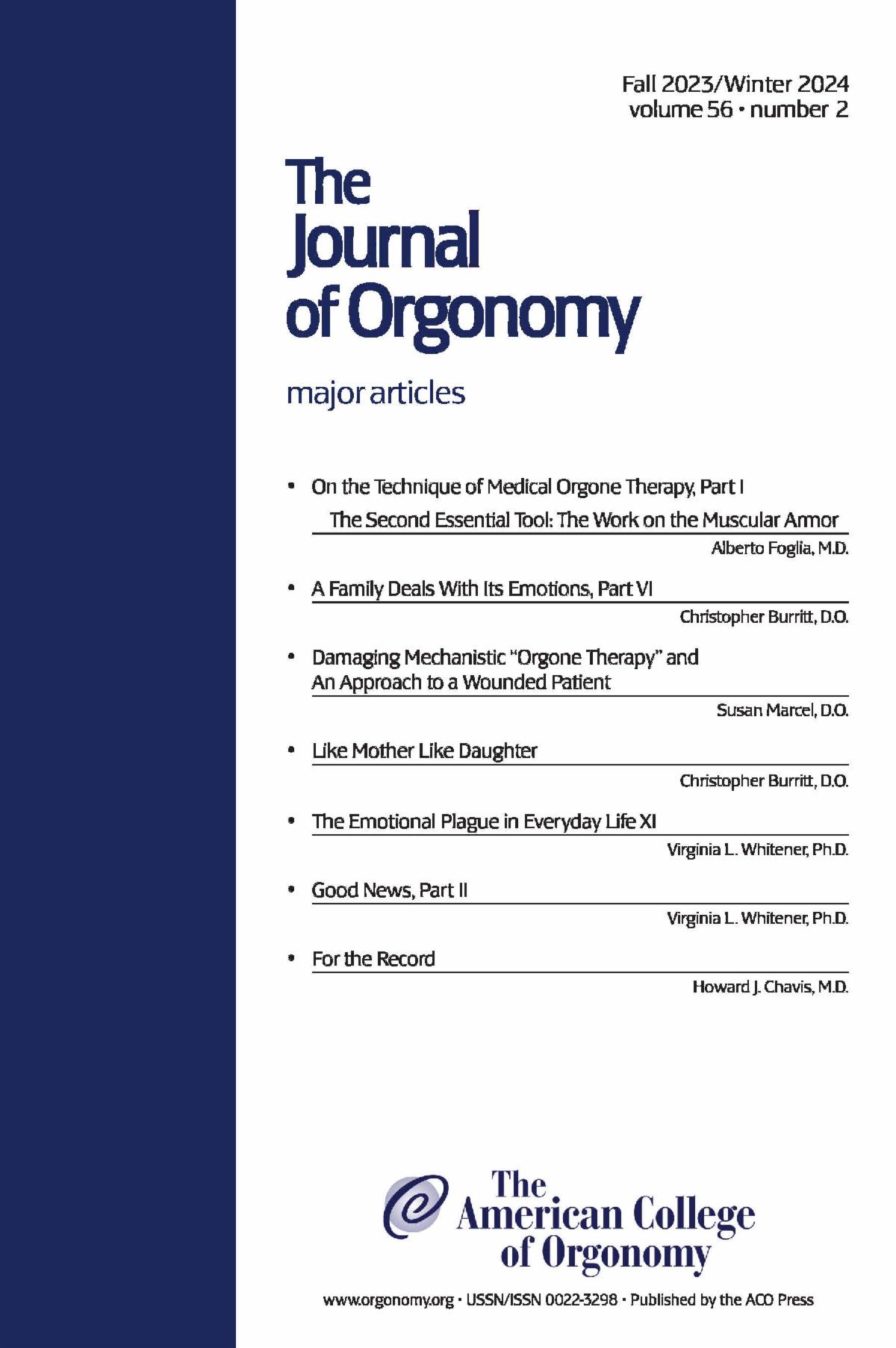
April 24, 2024
In this issue of the Journal, a feature-length article by Virginia L. Whitener, Ph.D. considers the character structure of Woodrow Wilson. In the 100 years since Wilson’s death, his legacy has invited controversy and debate. By focusing on Wilson’s character structure, however, Dr. Whitener is able to move beyond the realm of politics into the deeper realm of biology – revealing an emotional plague individual, whose destructive policies reflected his own pathological, highly-armored thinking. Drawing on the work of noted historians and Drs. Sigmund Freud, Wilhelm Reich, Elsworth Baker, and Charles Konia, Dr. Whitener demonstrates the long-term damage that can result from a single emotional plague character.
In addition to the long-form piece by Dr. Whitener, the articles and case studies in this issue bring us into deeper contact with emotional health: first, by identifying the methods and deadly effects of the emotional plague; second, by highlighting examples of genuine human connection and healthy core impulses – both in therapy and in daily life.
In his editorial, Howard J. Chavis, M.D. identifies the October 7 Hamas attacks on Israel as a direct manifestation of the emotional plague. Dr. Chavis brings powerful clarity to these horrific events, which have been misrepresented as political, religious, and ideological, particularly by the left.
Alberto Foglia, M.D. chronicles Reich’s discovery of muscular armor and explains the importance of addressing muscular armor in medical orgone therapy. Three vignettes presented by Dr. Foglia demonstrate the therapeutic efficacy and significance of this technique.
Christopher Burritt, D.O. shares Part VI of “A Family Deals with Its Emotions,” in which a father feels frustrated and out of sync with his wife, having thought that sexual intimacy between them would have returned to normal once their two daughters were no longer babies.
After many failed attempts with prior therapists, a 63-year-old retiree turns to Susan P. Marcel, D.O. for help with his longstanding depression. This moving account, in which the patient is finally able to express – and move beyond – his fear and sadness, underscores the vital importance of authentic contact between the patient and therapist.
In “Like Mother, Like Daughter,” Christopher Burritt, D.O. shares the treatment of Olivia, a withdrawn and sensitive 12-year-old girl. Seeing the positive change in Olivia, mom decides to begin her own course of therapy with Dr. Burritt, making life better, both for herself and for her daughter.
In this installment of “Good News,” Virginia L. Whitener, Ph.D. shares stories sent to the Journal, highlighting healthy, warm, and spontaneous human connection. “Good News” gives us much-needed perspective amid a steady stream of negative content from media outlets and social media platforms.
Howard J. Chavis, M.D. addresses a Wall Street Journal article from July 2023, which invokes numerous distortions of Reich’s work. In his response, Dr. Chavis reveals how Reich is misrepresented by both the left and the right, further noting that rigid political ideologies are themselves evidence of armored thinking.
If you do not already subscribe to the Journal, this is your opportunity to do so. In addition, when you subscribe or renew, the ACO will provide you with a free one-year electronic subscription that can be given to anyone you choose. Call (732) 821-1144 or email aco@orgonomy.org or subscribe today at the ACO Store.
The Journal of Orgonomy
Innovative, Intelligent, Insightful.
American College of Orgonomy
http://www.orgonomy.org