Aus Laskas Email-Verkehr Anfang der 2000er Jahre: Über die Einsamkeit

Schlagwörter: A.S. Neill, Biologie, Diderot, Einstein, Erich Fromm, Freud, Friedrich Kraus, Hegel, Intellektuelle, Junghegelianer, Karen Horney, La Mettrie, lsr-Projekt, Marcuse, Marx, Max Stirner, Paul Goodman, Philosophie, Spezialisten, splendid isolation, Wilhelm Reich
 Nachrichtenbrief
11. April 2024 um 15:23 |
American College of Orgonomy
Now Available:
Journal of Orgonomy Volume 56 no. 2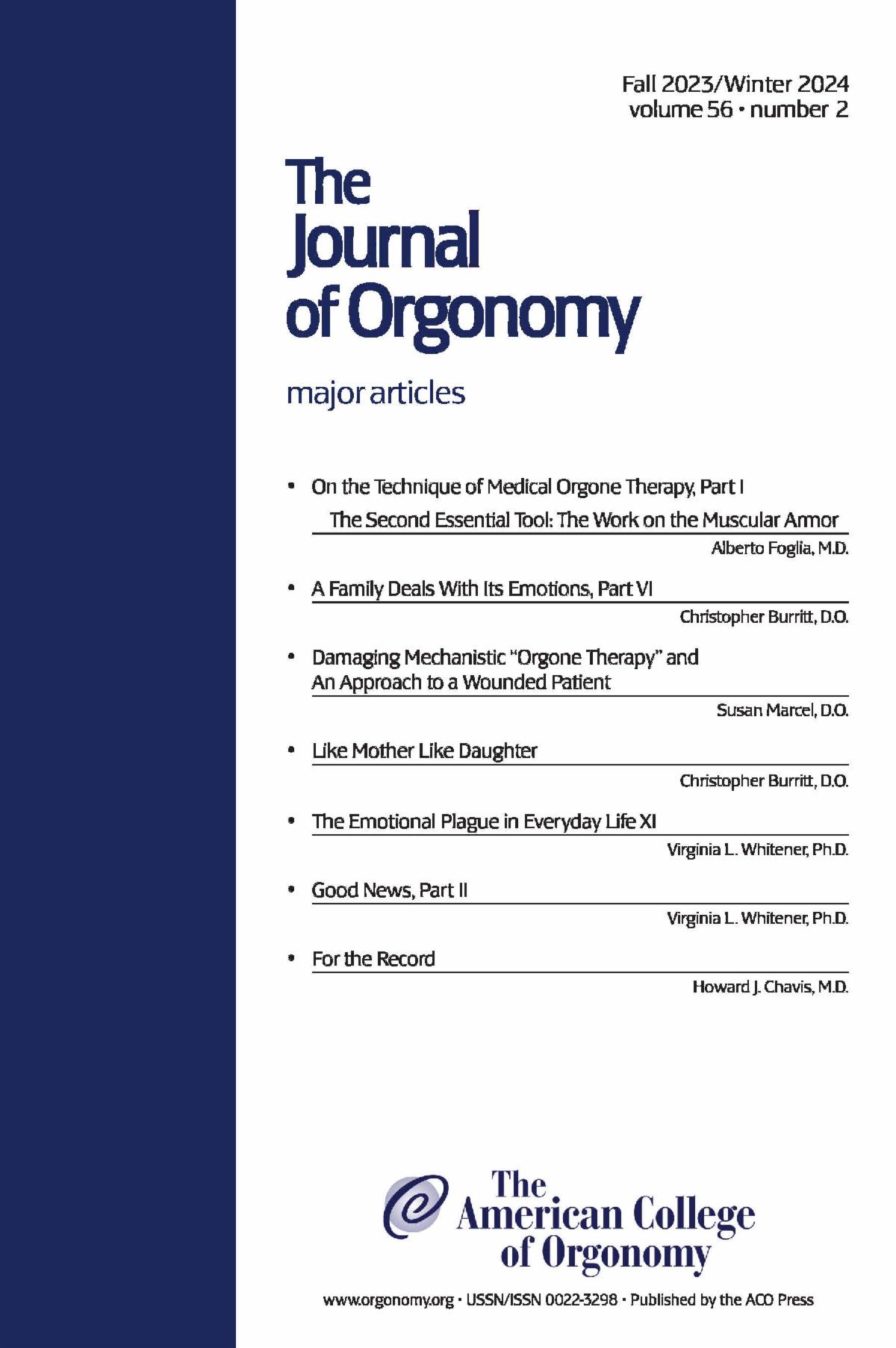
April 11, 2024
Our lives today unfold amid a deluge of information, much of it misleading. Media outlets, social media platforms, political pundits, and educators continually reframe the news of the day, sometimes within minutes of an event taking place. Rather than providing understanding, however, the vast majority of these responses introduce further confusion and foster negativity. As a result, our ability to see and feel things directly, for ourselves, is compromised.
In the face of such confusion and negativity, the articles and case studies in this issue of the Journal offer a counter narrative. Examples of clear, functional thinking and deep emotional connection – both in therapy and in daily life – reorient us, allowing us to recognize and embrace expressions of health and authentic optimism.
In his editorial, Howard J. Chavis, M.D. brings powerful clarity to the October 7 Hamas attacks on Israel. Identifying these attacks as a direct manifestation of the emotional plague, Chavis silences the misguided attempts to portray acts of terrorism as political, religious, and ideological.
Alberto Foglia, M.D. chronicles Reich’s discovery of muscular armor and explains its significance in medical orgone therapy today. Three vignettes demonstrate the benefits of addressing muscular armor in therapy, an approach that is more effective than character analysis alone.
Christopher Burritt, D.O. helps a father work through his feelings of disappointment and frustration in Part VI of “A Family Deals with Its Emotions.” By addressing his frustrations in therapy, the father is better able to tolerate his emotions and keep them from undermining life at home. This, in turn, leads to healthier, more loving relationships with his wife and young daughters.
Susan P. Marcel, D.O. shares the treatment of John, a 63-year-old retiree, whose earlier experiences with aggressive, contactless therapists worsened his sense of isolation and despondency. In this moving account, Dr. Marcel establishes deep emotional contact with John, which enables him to finally express his fear and sadness.
In “Like Mother, Like Daughter,” Christopher Burritt, D.O. recounts the successful treatment of Olivia, a withdrawn and sensitive 12-year-old girl. Seeing the positive change in her daughter, Olivia’s mom also begins treatment with Dr. Burritt. The case reveals that health, as well as pathology, can be contagious.
Virginia L. Whitener, Ph.D. offers a detailed case study of Woodrow Wilson, focusing on his presidency and involvement in the First World War. Drawing on the work of noted historians and Drs. Sigmund Freud, Wilhelm Reich, Elsworth Baker, and Charles Konia, this feature article explores Wilson’s character structure, highlighting the nature of emotional plague individuals and demonstrating how charismatic, high-energy plague characters can draw millions into their pathology, with disastrous results.
In this installment of “Good News,” Virginia L. Whitener, Ph.D. shares stories sent to the Journal that highlight healthy, warm, and spontaneous human connection. These vignettes invite us into deeper contact with one another, reminding us of the power and simple beauty of healthy human interactions.
Howard J. Chavis, M.D. addresses a Wall Street Journal article from July 2023 that invokes numerous distortions of Reich’s work. The WSJ article reveals that Reich’s work is misunderstood and misappropriated by both the left and the right. In his response, Chavis reminds us that political ideologies, whether left or right, are in themselves reflections of distorted, armored thinking.
If you do not already subscribe to the Journal, this is your opportunity to do so. In addition, when you subscribe or renew, the ACO will provide you with a free one-year electronic subscription that can be given to anyone you choose. Call (732) 821-1144 or email aco@orgonomy.org or subscribe today online at the ACO store.
The Journal of Orgonomy
Innovative, Intelligent, Insightful.
American College of Orgonomy
http://www.orgonomy.org
11. April 2024 um 23:42 |
Die LSR-Seite wurde endlich mit „Hypertext Transfer Protocol Secure“ (https) ausgestattet: https://www.lsr-projekt.de/